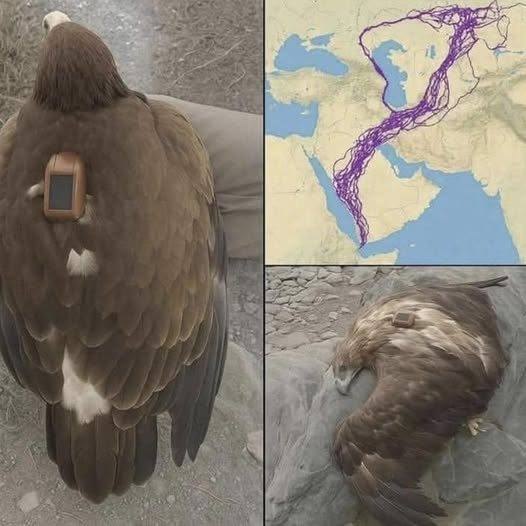

Every so often, a story from the natural world captures global attention not through spectacle, but through quiet revelation. One such case involved a single eagle whose movements were tracked for nearly two decades. What began as a routine scientific effort to study migration slowly turned into one of the most revealing examples of avian navigation ever recorded.
Researchers initially equipped the eagle with a lightweight GPS tracker to better understand long-distance migration routes common to its species. Eagles are known to travel far, but no one expected this one bird to provide such a detailed and consistent record over nearly 20 years. As data accumulated, scientists began to see something remarkable: a repeated journey stretching from northern regions of Russia to warmer areas of the Arabian Peninsula, followed year after year with striking precision.
What made the eagle’s migration so fascinating was not just the distance, but the strategy behind it. Rather than taking the shortest route between destinations, the bird consistently chose longer paths that followed landmasses, mountain ranges, and coastlines. At first glance, these routes appeared inefficient. Over time, however, the logic became undeniable.
Eagles rely heavily on thermals — rising columns of warm air created when sunlight heats the ground — to gain altitude and glide long distances while conserving energy. Over open oceans, these thermals are weak or nonexistent. Crossing large bodies of water would require constant flapping, quickly draining energy reserves and increasing the risk of exhaustion. By avoiding the sea and sticking to land, the eagle maximized efficiency and survival.
The GPS data revealed a bird deeply attuned to its environment. The eagle used mountain ranges to gain altitude, adjusted routes based on seasonal temperature shifts, and favored landscapes known to generate reliable thermals. These were not random choices, but the result of instinct refined by experience and evolution. Each journey reinforced successful decisions, creating a migration path shaped by memory as much as biology.
Scientists studying the data noted that the eagle’s behavior highlighted how birds navigate using a combination of tools. Visual landmarks, wind patterns, Earth’s magnetic field, and learned experience all play a role. In long-lived birds like eagles, this blend of instinct and memory becomes especially powerful, allowing individuals to fine-tune routes over many years.
Beyond science, the story resonated with the public on a deeper level. Eagles have long symbolized strength, clarity, and perspective across cultures. Watching a single bird navigate continents with quiet consistency prompted reflection on endurance and awareness — qualities often overlooked in a world obsessed with speed and shortcuts.
The eagle’s journey also carried a subtle lesson. The safest path is not always the shortest one. By choosing routes that supported long-term balance rather than immediate gain, the bird demonstrated a form of intelligence shaped by patience and restraint.
Thanks to modern tracking technology, scientists can now observe these hidden journeys in unprecedented detail. Each data point deepens understanding of migration, ecosystems, and the fragile connections that link distant regions.
In following one eagle’s path, researchers uncovered not just a migration route, but a reminder: nature often solves complex problems not through haste, but through harmony with the world around it.