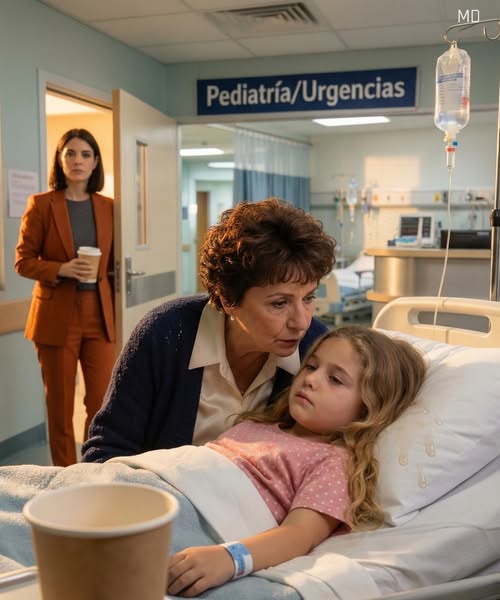

When my eight-year-old daughter was wheeled out of surgery, pale but safe, I felt something I hadn’t felt in weeks: relief.
For months, our lives had revolved around appointments, medications, test results, and hospital corridors that all started to look the same. Sitting in that waiting room for hours, staring at the clock, I had imagined every possible outcome. So when the surgeon told me the procedure had gone well, I finally exhaled.
She was going to be okay.
After settling her into recovery and watching her sleep, I realized I hadn’t eaten or had anything to drink since dawn. My hands were shaking from adrenaline and exhaustion. I told myself I’d just step out for ten minutes to grab a coffee from downstairs. She would still be resting when I got back.
I was wrong.
When I quietly pushed open the hospital room door, I immediately sensed something was off. The room felt tense. Heavy.
My daughter was awake.
She was curled on her side, trembling under the blankets. Her pillow was damp with tears. And standing beside her bed was my mother, Diane, leaning down and whispering something in a tone that made my stomach twist.
The moment my daughter saw me, her eyes widened — not with relief, but with fear.
“Mom?” she asked softly. “Is it true… that you don’t love me? Is that why I keep getting sick?”
I felt like the air had been knocked out of my lungs.
For a split second, I couldn’t process what she had just said. Then I looked at my mother. She avoided my eyes.
I didn’t explode. I didn’t scream.
Instead, I walked straight to my daughter’s bedside, sat down, and took her small shaking hands in mine.
“Sweetheart,” I said gently, brushing her hair from her face, “there is nothing in this world that could ever make me stop loving you. Nothing. You being sick is not your fault. And it’s not because of me. Sometimes our bodies just need extra help.”
She studied my face carefully, as if searching for proof. I stayed steady. Calm. Certain.
Then I turned to my mother.
“You should go home and rest,” I told her quietly.
She opened her mouth like she wanted to argue, but something in my expression must have stopped her. She grabbed her purse and left without another word.
The door clicked shut.
And I knew, in that moment, that something had shifted permanently.
Years earlier, when my daughter’s medical needs first became overwhelming, I had leaned heavily on my mother. Between hospital visits and trying to keep my job afloat, I trusted her to help manage a treatment fund we had set up — money specifically meant for surgeries, therapies, and medications.
At first, everything seemed fine.
But slowly, inconsistencies started to appear. Transfers I didn’t recognize. Withdrawals labeled vaguely. When I asked, there was always a reason: a temporary loan to help a cousin, an urgent bill, something that would be paid back quickly.
“She’s family,” I told myself.
I ignored the discomfort in my gut because I didn’t have the emotional energy to fight another battle.
But hearing what she had said to my daughter — in a hospital bed, hours after surgery — shattered whatever denial I had left.
That same night, sitting beside my daughter as she slept, I emailed my lawyer.
I asked for a full review of the account.
The following weeks were draining in ways I hadn’t expected.
The financial records showed repeated misuse of funds. Not just small amounts. Significant ones. Money that was supposed to secure my daughter’s treatments had been diverted elsewhere — sometimes with no documentation at all.
When confronted, my mother reacted with fury.
“I was trying to help everyone!” she insisted. “You’re overreacting. After everything I’ve done for you, this is how you repay me?”
But this wasn’t about repayment. It wasn’t about pride.
It was about my child.
Legal measures were put in place to secure what remained of the fund. Access was restricted. Documentation was gathered. Boundaries were formalized.
The hospital staff, quietly supportive, ensured future visits remained supervised and calm.
What hurt most wasn’t the money.
It was knowing that while my daughter lay in a vulnerable hospital bed, someone she trusted had planted a seed of doubt in her heart — a lie that she was somehow unworthy of love.
That kind of damage lingers far longer than financial loss.
As my daughter healed physically, I focused on helping her feel safe emotionally.
In simple, age-appropriate words, I explained that sometimes adults make poor choices. That grown-ups can be wrong. That no one — not even family — has the right to make her feel unloved.
She listened carefully.
Then she hugged me tighter than she had in weeks.
The legal process is still ongoing. The relationship with my mother may never recover. She continues to send messages blaming me for the consequences of her own actions.
I no longer respond.
For the first time in my life, I am not trying to fix her behavior or smooth things over to keep the peace.
I am choosing my daughter.
And strangely, that choice — painful as it has been — feels like clarity.
Walking back into that hospital room changed everything. I stepped out for ten minutes thinking the worst was behind us.
Instead, I uncovered a truth that forced me to protect my child in a way I hadn’t before.
Sometimes love isn’t just comfort and reassurance.
Sometimes it’s boundaries.
And this time, I didn’t hesitate to draw them.