

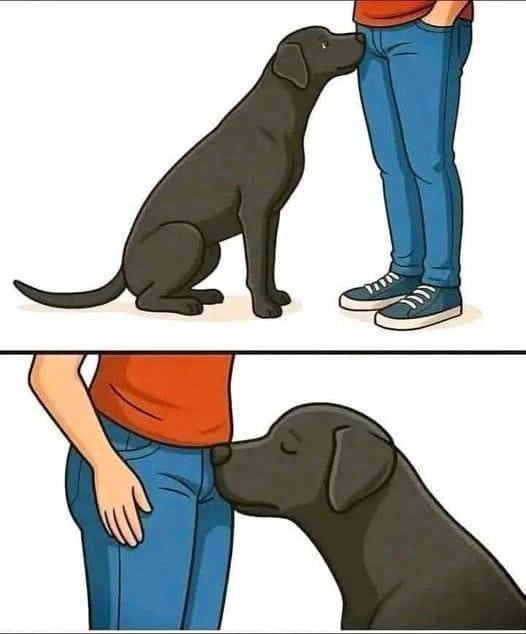
They don’t mean to embarrass you.
Yet there you are, frozen in horror, as your dog makes a beeline straight for a guest’s crotch. It feels rude, awkward, even invasive—one of those moments you wish you could undo instantly. But to your dog, nothing about this is inappropriate. There’s no social misstep, no awareness of embarrassment. What looks like chaos to you is, in their world, a completely normal form of communication.
Behind that uncomfortable moment lies something far more fascinating: a powerful instinct shaped by evolution, driven by scent, and rooted in how dogs understand the world.
Dogs don’t rely on vision the way humans do. While we interpret facial expressions, tone of voice, and body language, dogs primarily navigate life through smell. Their sense of smell is estimated to be tens of thousands of times more sensitive than ours, allowing them to pick up details we could never perceive. Every scent carries information—layers of it—telling a story about the person or animal they’re investigating.
When your dog greets someone by sniffing their crotch, they’re not being inappropriate. They’re gathering data.
This behavior is tied to the detection of pheromones—chemical signals that convey information about identity, emotional state, and even biological traits. These signals are strongest in areas where sweat glands are more active, particularly around the groin. For a dog, this is simply the most efficient place to “read” someone. It’s the equivalent of a handshake, eye contact, and a quick conversation all rolled into one.
In fact, dogs can often detect things we’re completely unaware of. They may pick up on hormonal changes, illness, stress levels, or even subtle emotional shifts. This is why some dogs can sense anxiety, illness, or pregnancy before a person consciously recognizes it. What seems like an awkward social blunder is, in reality, a highly sophisticated sensory process.
Still, understanding why dogs do it doesn’t make it any less uncomfortable when you’re standing there with guests watching.
The good news is that you don’t have to choose between respecting your dog’s instincts and maintaining social boundaries. With the right approach, you can guide your dog toward more acceptable greeting behaviors without confusion or punishment.
Training is key—but it doesn’t have to be complicated.
Dogs respond best to calm, consistent direction. When a guest arrives, you can anticipate your dog’s excitement and redirect it before the behavior happens. Commands like “sit,” “stay,” or “down” give your dog an alternative action. Instead of rushing forward to investigate, they learn to pause, wait, and engage in a way that’s more appropriate for human social settings.
Positive reinforcement plays a huge role here. When your dog chooses the calmer behavior—even for a moment—reward it with treats, praise, or affection. Over time, they begin to associate polite greetings with positive outcomes. The goal isn’t to suppress their curiosity entirely, but to shape how and when they express it.
It’s also helpful to manage introductions more intentionally. Allow your dog to approach guests in a controlled way, perhaps after they’ve settled or when you’ve given a clear signal. This reduces the intensity of that first interaction, which is often when the behavior is most exaggerated.
Consistency matters. If the rules change from one situation to another, dogs can become confused. But when expectations are clear and reinforced regularly, they adapt surprisingly quickly.
There’s also a deeper shift that happens when you understand the behavior.
Instead of seeing it as something embarrassing or “bad,” you start to recognize it as part of your dog’s natural language. That perspective doesn’t mean you allow it unchecked—but it does change how you respond. You move from frustration to guidance, from reacting to understanding.
And that understanding strengthens your bond.
Dogs aren’t trying to misbehave. They’re trying to communicate in the only way they know. When you meet them halfway—by setting boundaries while respecting their instincts—you create a relationship built on clarity and trust.
So the next time your dog heads in that direction, you’ll still feel that flash of awkwardness—but you’ll also know what’s really happening. It’s not a social disaster. It’s curiosity, instinct, and communication all at once.
And with a little training and patience, it can become just another small, manageable part of sharing your life with a dog.