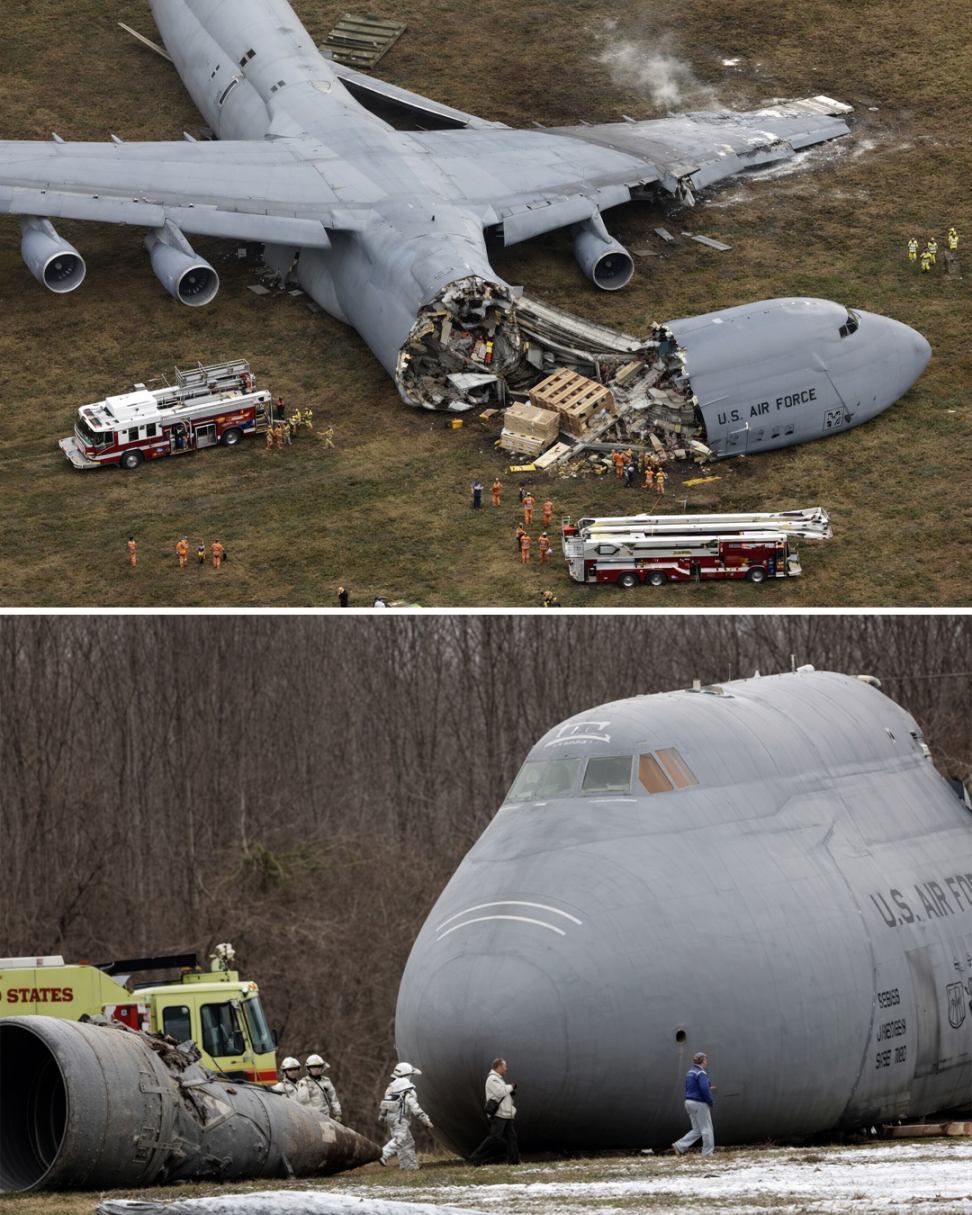

What began as a routine military flight quickly turned into a moment aviation experts and first responders would never forget. Shortly after taking off from Dover Air Force Base, a massive U.S. Air Force C-5 Galaxy — one of the largest aircraft ever built — suffered a sudden and severe mechanical failure that pushed the crew into an immediate emergency.
According to official reports, engine number two failed just moments after departure. The timing left little room for error. The pilots declared an emergency and attempted to bring the aircraft back to the runway, relying on intense training designed for situations most people never imagine facing. For a brief moment, there was hope the aircraft could still be saved.
But physics had other plans.
With limited altitude and reduced power, the aircraft struggled to maintain controlled flight. Before it could reach the runway, the C-5 descended into a nearby field. The impact was violent, yet strangely restrained compared to what could have happened. The fuselage fractured just behind the cockpit, splitting the aircraft into sections. The nose slid to a stop facing the runway it had been desperately trying to reach, while the tail section separated and came to rest hundreds of meters away. One engine was torn loose entirely and thrown forward by the force of the crash.
Then came the moment that defied every expectation.
There was no fire.
In crashes involving aircraft of this size, fire is often what turns disaster into tragedy. In this case, the absence of flames became the difference between loss and survival. Emergency crews rushed to the scene, unsure of what they would find inside the shattered remains of the aircraft.
Inside were 17 crew members.
Every single one of them survived.
Some sustained minor injuries, but none were killed. Investigators later pointed to several crucial factors that made survival possible. Most importantly, the aircraft’s wings were level at the moment of impact. This seemingly small detail dramatically reduced rotational forces and prevented the plane from cartwheeling or breaking apart even further. In aviation, precision in the final seconds can mean everything.
First responders described a scene that felt surreal: a gigantic aircraft torn into pieces, yet filled with survivors walking away from wreckage that should have been fatal. Firefighters and military personnel worked quickly and methodically, securing the area, assisting the injured, and ensuring there were no secondary hazards.
The C-5 Galaxy is designed to carry enormous loads — tanks, helicopters, and humanitarian supplies across continents. But on that day, it carried something far more important: proof that training, engineering, and discipline save lives when seconds matter most.
An investigation into the engine failure and mechanical sequence began immediately. The goal was not blame, but understanding — learning exactly what went wrong to prevent future crews from facing the same danger.
To the public, images of the broken aircraft were shocking. Its sheer size made the crash feel unreal, almost cinematic. But beneath the twisted metal lies a quieter story: one of calm decisions under extreme pressure, systems that worked just enough, and human lives spared against overwhelming odds.
This was not a story about a plane falling from the sky. It was a story about how close disaster can come — and how preparation, experience, and a bit of fortune can turn the unthinkable into survival.