

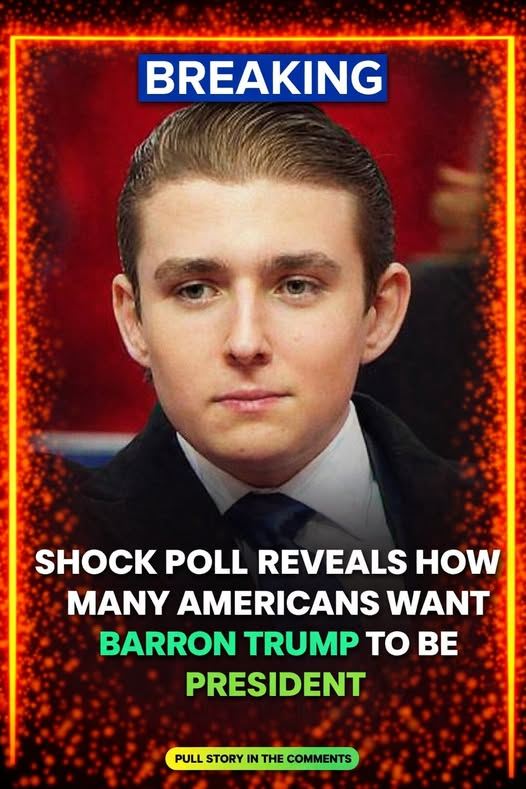
The number is staggering.
A new national poll has ignited a wave of debate across the country, revealing how many Americans—particularly within one political base—are already open to the idea of 20-year-old Barron Trump one day stepping into the Oval Office. For some, the conversation doesn’t stop at future possibility. It extends into something far more controversial: whether the rules themselves should change to make that future come sooner.
At the center of the discussion is a constitutional reality. The U.S. Constitution clearly states that a presidential candidate must be at least 35 years old. It’s a rule that has stood for centuries, shaping the timeline of every presidential ambition in American history. Yet according to the poll, a notable portion of respondents—particularly among Republican voters—are open to reconsidering that threshold.
The data comes from a Daily Mail/J.L. Partners survey, which found that nearly half of Republican voters would support Barron Trump as a future president. Even more striking, around 40 percent indicated they would consider supporting a constitutional change that would allow him to run before reaching the required age.
For supporters, this isn’t just about age—it’s about identity, continuity, and legacy.
They point to Barron’s background as the son of Donald Trump, a figure who continues to shape political discourse in the country. To them, Barron represents a continuation of a political movement they feel strongly about. His reserved public image, combined with reports of his quiet involvement in media strategy during the 2024 campaign cycle, has only added to the perception that he may eventually step into a larger role.
There is also a symbolic element at play.
For some, Barron embodies a new generation—someone who has grown up around politics but has not yet been defined by it publicly. That sense of mystery can be powerful, allowing supporters to project expectations, hopes, and ideas onto a figure who has largely remained out of the spotlight.
But beyond that base, the reaction is far more divided.
Among the general population, enthusiasm drops significantly. Polling suggests that only about a quarter of Americans would support rewriting constitutional rules to allow a younger candidate like Barron Trump to run for president. Meanwhile, a larger portion—around 42 percent—oppose the idea outright.
For critics, the conversation raises deeper concerns.
They argue that changing fundamental requirements for a single individual risks undermining the principles of equal standards and institutional stability. The age requirement, they point out, was designed to ensure a certain level of maturity and experience in leadership. Altering it, especially in response to a specific figure, is seen by some as a move toward personality-driven politics rather than system-based governance.
There is also the broader concern about political dynasties.
To some observers, the idea of Barron Trump as a future president reflects a trend toward family-based influence in politics—something that has appeared in various forms throughout U.S. history. For these critics, the push feels less like a grassroots movement and more like an extension of an already powerful political brand.
Yet for supporters, that same connection is a strength, not a weakness.
They view loyalty to a political figure and their family as a continuation of values they believe have reshaped the country. In that sense, support for Barron is not just about him personally—it’s about preserving a direction they want to see maintained.
What makes the situation even more unique is Barron’s own silence.
Unlike many public figures discussed at this level, he has made very few public statements and has not openly expressed political ambitions. This absence of direct input creates a vacuum—one that is quickly filled by speculation, projection, and debate from both sides.
In many ways, the conversation says as much about the current political climate as it does about Barron himself.
It reflects a country deeply divided, where even hypothetical futures can spark intense discussion. It highlights how quickly public attention can shift, and how narratives can form around individuals who have not actively sought them.
At the same time, it raises questions about the role of institutions.
The Constitution has long served as a stabilizing framework, setting boundaries and expectations for leadership. Debates about changing it are not new, but they are always significant, particularly when tied to specific individuals or moments.
As the discussion continues, one thing remains clear: this is not just about a single person or a single poll.
It’s about how Americans view leadership, tradition, and the balance between change and continuity. It’s about whether the rules that have defined the system for generations should remain fixed, or whether they can evolve in response to shifting political dynamics.
For now, Barron Trump remains largely out of the public conversation in his own voice.
But around him, the conversation is only growing louder.
And in that space—between speculation and reality, between support and skepticism—a new chapter of political debate is already beginning to take shape.