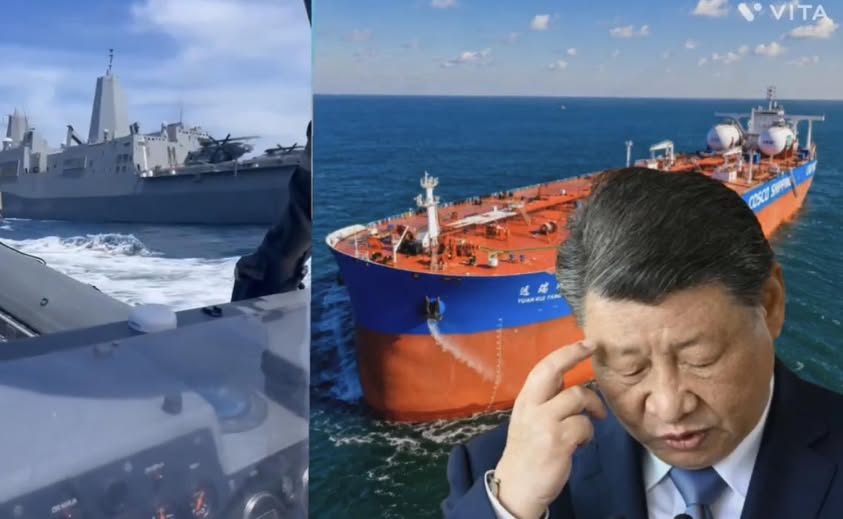
The reported U.S. naval blockade targeting Iranian oil exports in the Strait of Hormuz—if accurate—marks a dramatic escalation in an already fragile geopolitical environment. The Strait of Hormuz is not just another maritime corridor; it is arguably the most strategically important energy chokepoint in the world. Roughly one-fifth of global oil consumption passes through this narrow waterway, making any disruption there immediately felt across international markets, supply chains, and political systems.
A move to restrict Iranian oil exports through naval enforcement would signal a shift away from indirect pressure—such as sanctions and diplomatic isolation—toward direct physical control of trade flows. That distinction matters. Sanctions rely on compliance, enforcement networks, and financial leverage. A naval blockade, by contrast, introduces hard power into the equation, raising the stakes significantly and narrowing the margin for de-escalation.
From a strategic standpoint, the goal behind such an action would be clear: choke off Iran’s primary revenue stream. Oil exports are the backbone of Iran’s economy, and even under sanctions, the country has managed to sustain significant flows—particularly to buyers like China. Cutting off that lifeline, even partially, would put immense pressure on Tehran’s leadership, especially if sustained over time. Revenue losses in the hundreds of millions of dollars per day would quickly ripple through Iran’s domestic economy, affecting currency stability, inflation, and the government’s ability to fund both domestic programs and regional activities.
However, the effectiveness of a blockade depends on consistency and enforcement credibility. The reported behavior of tankers reversing course—whether confirmed or anecdotal—illustrates a key psychological dimension: deterrence. Maritime commerce operates heavily on risk calculation. If shipowners, insurers, and operators perceive a high likelihood of interception, seizure, or escalation, they will avoid the area even without direct confrontation. In that sense, the mere presence of a credible naval threat can achieve results without firing a shot.
China’s role in this equation is especially important. Over recent years, China has emerged as one of the primary buyers of Iranian crude, often through indirect channels or discounted arrangements. Any disruption to that flow introduces not only economic friction but also geopolitical tension. Beijing tends to avoid direct military confrontation in distant theaters, but it is deeply invested in energy security. If its access to Iranian oil is curtailed, China faces a choice: seek alternative suppliers at potentially higher costs, quietly negotiate around the blockade, or test the limits of U.S. enforcement.
None of these options are simple. Testing a U.S.-enforced blockade would carry significant risk, particularly if Washington has clearly signaled a willingness to escalate. At the same time, accepting the restriction could be seen domestically and internationally as a concession of strategic vulnerability. This tension highlights a broader reality: the Strait of Hormuz is not just a regional issue—it is a global pressure point where the interests of major powers intersect.
For Iran, the implications are immediate and complex. Historically, Tehran has responded to pressure with a mix of asymmetric tactics and calibrated escalation. This includes the use of fast-attack craft, naval mines, drones, and proxy forces across the region. A blockade targeting its oil exports could trigger responses designed to raise the cost of enforcement without provoking full-scale war. For example, Iran might increase harassment of shipping, conduct limited strikes on energy infrastructure, or signal its ability to disrupt traffic more broadly.
Such actions would aim to shift the narrative from a one-sided enforcement operation to a contested environment where risks are shared. In effect, Iran’s strategy would likely revolve around making the blockade economically and politically unsustainable over time.
The United States, in turn, would face its own set of challenges. Maintaining a naval blockade is resource-intensive and requires constant vigilance. The rules of engagement must be carefully defined to avoid unintended escalation, particularly in a congested and sensitive maritime zone. Even a single miscalculation—such as a confrontation that results in significant damage or casualties—could rapidly expand the scope of the conflict.
Moreover, Washington would need to manage the reaction of its allies. While some partners may support efforts to constrain Iran’s nuclear ambitions or regional influence, they may also be wary of actions that risk destabilizing global energy markets. European countries, in particular, have historically favored diplomatic approaches and may push for de-escalation if the situation threatens economic stability.
Energy markets themselves would respond almost instantly to any credible disruption in the Strait of Hormuz. Oil prices are highly sensitive to perceived supply risks, and even the possibility of reduced flows can drive volatility. Higher prices could benefit some producers in the short term but would also increase costs for consumers and potentially slow global economic growth. In a tightly interconnected world, such effects would not remain confined to the energy sector.
There is also a legal dimension to consider. Naval blockades occupy a complex space in international law, particularly outside of formally declared wars. Questions would arise regarding the legitimacy of the action, the treatment of neutral vessels, and the broader implications for freedom of navigation. These issues could become points of contention in international forums, further complicating the situation.
At a broader level, the scenario reflects a shift toward more assertive forms of economic statecraft. Rather than relying solely on financial systems or regulatory frameworks, states are increasingly willing to use physical control over key nodes—whether maritime routes, supply chains, or infrastructure—to achieve strategic objectives. This trend raises important questions about the future of globalization and the stability of the systems that underpin it.
Ultimately, the success of such a blockade—if indeed implemented—would depend on a delicate balance of pressure and restraint. Too little enforcement, and it risks being ineffective. Too much escalation, and it could trigger a wider conflict with unpredictable consequences. The challenge lies in sustaining enough pressure to achieve political goals while avoiding the tipping points that lead to broader instability.
What remains clear is that the Strait of Hormuz will continue to be a focal point of global attention. Its strategic importance ensures that any development there—real or perceived—will have far-reaching implications. Whether through direct confrontation, economic pressure, or diplomatic maneuvering, the dynamics surrounding this narrow stretch of water will shape not only regional security but also the broader trajectory of international relations in the years ahead.