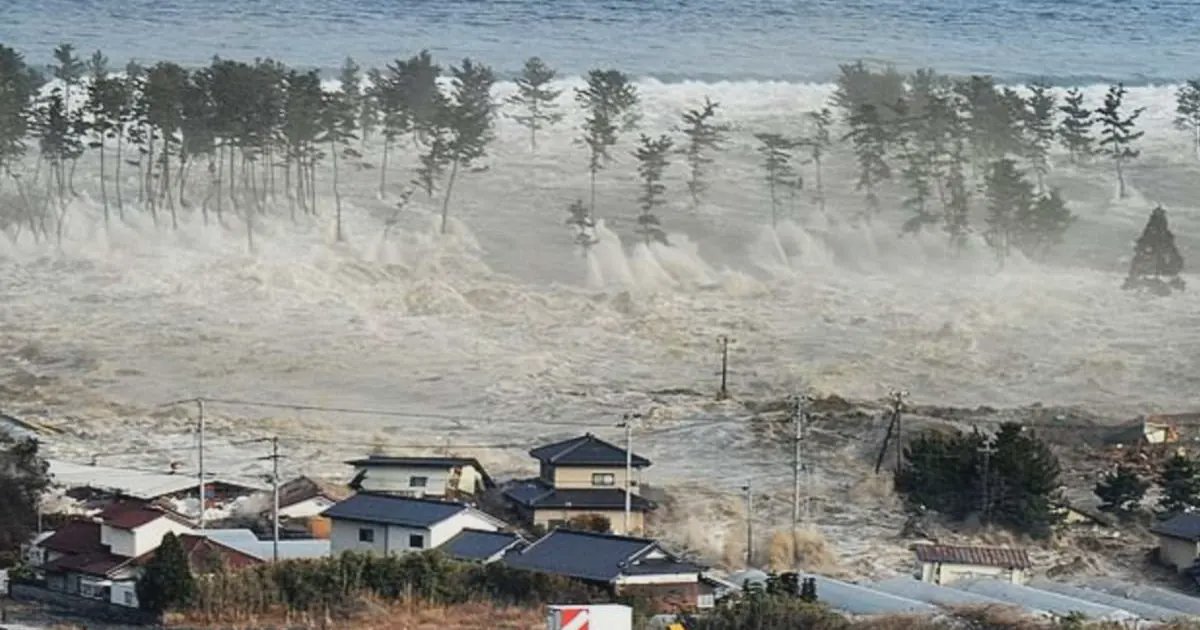
The following is a fictional disaster narrative set in Miyako, Japan. The events, earthquake, tsunami, casualties, and destruction described below are fictional and should not be interpreted as a report of a real earthquake occurring in Miyako.
At first, no one in Miyako understood what was happening.
It began with a vibration so subtle that some residents mistook it for a passing truck.
A hanging light swung gently from the ceiling.
And within seconds, the ordinary sounds of morning disappeared beneath the deep, continuous roar of a city being violently shaken.
The fictional earthquake had struck beneath the ocean with an extraordinary magnitude of 9.1.
There was no warning that could prepare people for the force that followed.
In homes throughout the coastal city of Miyako, people grabbed walls, doorframes, tables, anything that might keep them upright.
Children cried as parents pulled them close.
Outside, utility poles swayed violently, power lines twisted, and parked vehicles bounced against the pavement.
For what felt like minutes, the entire world had become motion.
Then, almost as suddenly as it had begun, the strongest shaking weakened.
The kind of silence that comes when people are waiting to find out what has happened.
Some stood in the streets looking at damaged buildings.
But communication networks were already beginning to fail.
And somewhere beyond the coastline, beneath the dark surface of the Pacific Ocean, another danger was already forming.
One far larger than the earthquake itself.
Emergency sirens suddenly began sounding across Miyako.
Their voices echoed through neighborhoods.
Loudspeakers repeated emergency instructions.
Residents were told to move immediately toward higher ground.
For many people, the meaning was instantly clear.
A powerful tsunami was moving toward the coast.
People who had spent their lives near the ocean knew what that meant.
They knew that the sea could become something entirely different after a major offshore earthquake.
Older residents were helped from damaged houses.
Others grabbed documents, medicine, water, or photographs.
There was no time to decide what was important.
And everyone understood that every minute mattered.
People near the coastline noticed the ocean behaving differently.
Wet sand appeared where water had been moments earlier.
Small boats tilted awkwardly in exposed areas.
Fish were visible in places that were normally underwater.
But those who understood what the retreating water could mean were terrified.
The water advanced across the coast with enormous force.
For a brief moment, the barrier appeared to hold.
A parked car struck another vehicle and spun sideways.
A small truck was pushed across an intersection.
Objects that had been stationary only seconds earlier became dangerous projectiles.
Water poured through low-lying neighborhoods.
Residents who had not evacuated quickly enough ran toward higher ground.
Emergency workers shouted directions through loudspeakers.
The city had become a maze of water, debris, darkness, and panic.
One fictional family, the Tanakas, had been eating breakfast when the earthquake struck.
Their youngest daughter, Hana, began crying.
Her mother picked up a small emergency bag they had prepared months earlier.
Downstairs, neighbors were already moving toward the evacuation route.
Two younger residents stopped to help him.
Someone shouted that another wave was coming.
Behind them, the sound of the ocean grew louder.
The earthquake had damaged electrical infrastructure across parts of the city.
Buildings that had been brightly illuminated only minutes earlier became dark silhouettes.
Emergency generators activated in some facilities.
Without electricity, everyday systems became suddenly difficult.
Residents tried to charge phones from vehicles and portable batteries.
Thousands of people were trying to contact relatives simultaneously.