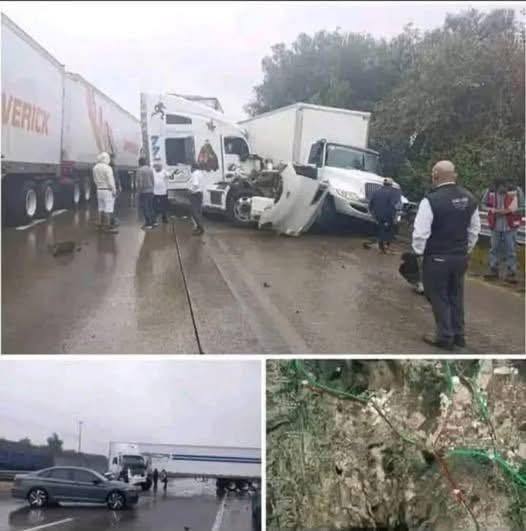
Major Multi-Vehicle Collision Disrupts Traffic on Mexico–Querétaro Highway in Huehuetoca
A significant traffic incident occurred in the State of Mexico on Wednesday, November 20, when a large trailer truck was involved in a multi-vehicle collision along the Mexico–Querétaro Highway. The crash took place at kilometer marker 059+000, within the jurisdiction of Huehuetoca, and led to major disruptions on one of the country’s most heavily traveled transportation corridors.
The event drew immediate attention from motorists, emergency responders, and transportation authorities due to the scale of the collision, the number of vehicles affected, and the resulting traffic paralysis that followed. Although initial reports confirmed property damage and multiple injuries, fortunately no fatalities were reported at the scene at the time of initial assessments.
The Mexico–Querétaro Highway and Its Importance
The Mexico–Querétaro Highway is one of the most strategically important roadways in central Mexico. It connects the country’s capital region with key industrial and commercial zones in the Bajío area, serving as a primary route for freight transport, commuter traffic, and long-distance travel.
On any given weekday, the highway experiences heavy traffic volumes, particularly during peak morning and afternoon hours. Thousands of passenger vehicles and commercial trucks share the roadway, making traffic flow highly sensitive to sudden slowdowns or accidents.
Because of its importance, any disruption along this highway can quickly escalate into widespread congestion affecting surrounding roads, alternative routes, and regional logistics operations.
Sequence of Events Leading to the Collision
According to preliminary information gathered from authorities and eyewitness accounts, the accident occurred during a period of intense traffic flow. Vehicles were reportedly moving in dense formation, with limited spacing between them due to congestion.
Witnesses stated that a trailer truck traveling along the highway was moving at a relatively high speed when traffic conditions ahead began to slow down. In what appears to have been a critical moment of delayed reaction, the driver was unable to bring the vehicle to a complete stop in time.
As a result, the trailer collided with several vehicles ahead of it in a chain-reaction impact. The force of the collision caused immediate damage to multiple cars and led to the trailer losing stability on the roadway.
Following the initial impact, the heavy vehicle reportedly skidded and rotated, eventually coming to rest in a sideways position across the highway. This unusual positioning effectively blocked all north-to-south lanes of traffic, bringing movement along the route to a near-complete standstill.
Immediate Aftermath and Traffic Disruption
The consequences of the accident were felt almost immediately across the surrounding transportation network. With the trailer obstructing multiple lanes, vehicles approaching the area were forced to slow to a halt, resulting in rapidly forming traffic queues extending for several kilometers.
Drivers traveling behind the incident site experienced significant delays, with some reporting extended waiting times lasting over two hours before alternative routes could be established or traffic flow restored.
The blockage also had ripple effects on nearby roads and alternate highways, as drivers attempted to reroute their journeys to avoid the congestion. This contributed to secondary traffic buildup in surrounding areas.
Emergency Response and Rescue Operations
Emergency services were promptly dispatched to the scene shortly after the collision was reported. Response teams included highway patrol officers, firefighting units, and medical personnel trained in road accident response.
Their first priority was to secure the area and prevent additional collisions, especially given the high traffic density and limited visibility caused by the blockage. Officers quickly established traffic control points, redirecting vehicles away from the crash site and attempting to manage congestion buildup.
Paramedics assessed individuals involved in the collision, providing on-site medical attention where necessary. Some occupants were transported to nearby hospitals for precautionary evaluation, although most injuries reported were considered minor.
Firefighters and rescue personnel worked alongside highway authorities to inspect the damaged vehicles, check for trapped occupants, and ensure that no fuel leaks or fire hazards posed additional risks.
Vehicle Removal and Road Clearance Efforts
Due to the size and weight of the trailer truck involved, specialized equipment was required to remove it from the roadway. A heavy-duty crane was brought in to reposition the vehicle, which had become lodged diagonally across multiple lanes.
The recovery process was complex and time-consuming, as crews had to carefully coordinate lifting and towing operations while maintaining safety protocols in a high-traffic environment.
In addition to removing the trailer, teams also worked to clear debris scattered across the highway. Broken vehicle parts, glass, and other materials had to be collected to ensure that the road surface was safe for reopening.
Traffic lanes were gradually reopened in phases as cleanup progressed, although full restoration of normal traffic flow took several hours.
Possible Contributing Factors Under Investigation
While the exact cause of the accident has not yet been officially confirmed, authorities have identified several potential contributing factors that are currently being investigated.
1. Excessive Speed and Following Distance
One of the primary considerations is that the trailer may have been traveling too fast relative to surrounding traffic conditions. In congested highway environments, maintaining appropriate speed and safe following distance is essential to allow sufficient reaction time.
Preliminary assessments suggest that the truck may not have had enough space to safely brake when traffic ahead slowed, increasing the likelihood of a collision.
2. Mechanical Condition of the Vehicle
Another key area of investigation involves the mechanical state of the trailer, particularly its braking system. Heavy-duty trucks rely on complex braking mechanisms, and any malfunction or reduced efficiency can significantly impair stopping ability.
Authorities are examining whether routine maintenance was properly conducted and whether any mechanical failure may have contributed to the inability to stop in time.
3. Weather and Road Surface Conditions
Environmental conditions at the time of the incident are also being reviewed. Reports indicate that there may have been light rainfall earlier in the day, which could have left the road surface damp.
Even minor moisture on asphalt can reduce tire grip, especially for large and heavy vehicles. Reduced traction increases braking distance and may contribute to loss of control during sudden stops.
4. Driver Fatigue and Human Factors
Long-distance commercial driving often involves extended hours on the road, and fatigue is a recognized risk factor in traffic safety. Authorities are investigating whether the driver had adequate rest prior to the trip and whether fatigue may have affected reaction time or decision-making.
Social Sciences
Driver logs, schedules, and rest periods are expected to be reviewed as part of the ongoing inquiry.
5. Traffic Density and Sudden Slowdowns
The Mexico–Querétaro Highway is known for frequent congestion, especially during working hours. Sudden reductions in traffic speed are common, and drivers must remain highly attentive to changing conditions.
Failure to anticipate abrupt slowdowns can result in chain-reaction collisions, particularly in heavy traffic involving large commercial vehicles.
Impact on Commuters and Regional Mobility
The accident had a substantial impact on commuters, freight operators, and regional transportation efficiency. With one of the main highway corridors partially blocked, thousands of drivers experienced delays that disrupted travel schedules and logistics operations.
Freight transport companies reported temporary delays in deliveries, while commuters faced extended travel times and congestion extending into connecting routes.
The incident also highlighted the vulnerability of major transportation corridors to single-point disruptions, especially in high-volume traffic environments.
Safety Recommendations and Official Response
In the aftermath of the crash, transportation authorities reiterated the importance of safe driving practices, particularly for operators of heavy vehicles.
Officials emphasized several key safety principles:
- Maintaining safe and consistent speed according to traffic conditions
- Ensuring proper vehicle maintenance, especially braking systems
- Avoiding driver fatigue through adequate rest periods
- Increasing awareness of changing traffic patterns
- Respecting safe following distances, particularly in congested areas
A highway safety representative noted that incidents of this nature underscore the importance of preventive measures and responsible driving behavior across all vehicle categories.
Investigation Process and Next Steps
Authorities continue to investigate the exact circumstances surrounding the collision. This includes a detailed examination of the trailer truck, review of any available surveillance footage from highway cameras, and collection of statements from witnesses and involved drivers.
If evidence indicates negligence, mechanical violations, or regulatory non-compliance, further legal and administrative actions may be pursued.
Investigators aim to reconstruct the sequence of events leading up to the collision to better understand how the situation escalated and to identify any preventable factors.
Broader Road Safety Considerations
Beyond the immediate incident, the crash serves as a broader reminder of the risks associated with high-density highway travel. Even brief lapses in attention or minor mechanical issues can have serious consequences when multiple vehicles are involved.
High-speed road networks that carry both passenger and commercial traffic require strict adherence to safety protocols to minimize risks. This includes regular vehicle inspections, driver training, and effective traffic management systems.
Gradual Return to Normal Traffic Conditions
By the end of the day, authorities had managed to partially restore traffic flow along the affected section of the highway. Although congestion remained for several hours, gradual clearing of the roadway allowed vehicles to resume movement.
As normal traffic conditions returned, officials continued monitoring the area to ensure no secondary incidents occurred and that road conditions were safe for continued use.
Conclusion
The multi-vehicle collision in Huehuetoca on the Mexico–Querétaro Highway highlights the significant impact that a single traffic incident can have on a major transportation network. While no fatalities were reported, the disruption, vehicle damage, and extended delays underscored the importance of road safety awareness and preventive measures.
As investigations continue, authorities are focusing on identifying the precise causes of the crash and implementing lessons that may help reduce the likelihood of similar incidents in the future. For commuters and transport operators alike, the event serves as a reminder of the need for caution, preparedness, and strict adherence to road safety standards