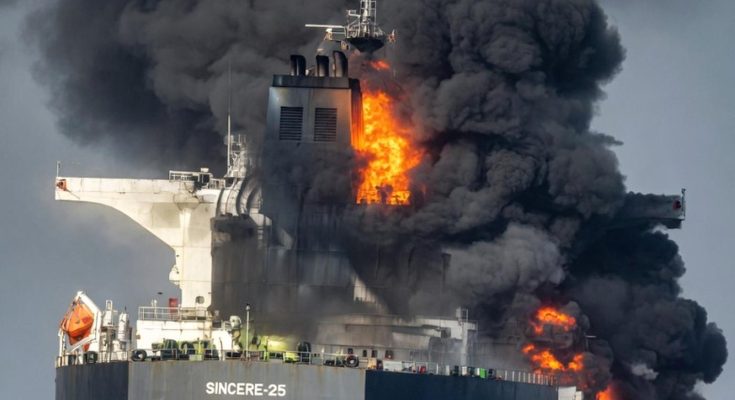
The tension had been building for days in one of the world’s most volatile maritime chokepoints: the Strait of Hormuz. A narrow passage responsible for a significant portion of the globe’s oil shipments, it has long stood as a flashpoint between Iran and the United States. But on this day, the standoff escalated into something far more serious—an unmistakable show of force that sent a clear message across the region and beyond.
According to reports from U.S. defense officials, an Iranian vessel attempted to push through a naval blockade imposed as part of heightened security operations in the area. The blockade itself had been established following a series of provocations, intelligence warnings, and concerns over maritime safety. For the United States, maintaining control over these critical waters wasn’t just about geopolitics—it was about ensuring the uninterrupted flow of global commerce and deterring hostile actions.
From the outset, the situation was handled by the book. U.S. Navy ships issued repeated warnings to the approaching Iranian vessel, urging it to alter course and comply with international maritime protocols. These warnings weren’t subtle or ambiguous. Over a span of six hours, communication channels remained open, with American forces making it abundantly clear that the vessel was entering a restricted zone and risked serious consequences if it continued.
But the Iranian crew did not comply.
As tension mounted, the standoff evolved into a high-stakes test of resolve. U.S. commanders faced a critical decision: allow the vessel to proceed and risk undermining the blockade, or take decisive action to enforce it. According to military sources, the decision was ultimately made to neutralize the threat in a controlled and precise manner.
What followed was swift and calculated. Using the ship’s 5-inch naval gun, U.S. forces targeted the engine room of the Iranian vessel. The strike was not intended to destroy the ship outright but to disable it—removing its ability to maneuver while minimizing loss of life. The precision of the operation reflected both advanced targeting capabilities and a clear strategic objective: stop the vessel without escalating into full-scale conflict.
Within moments, the Iranian ship was dead in the water.
With the vessel immobilized, U.S. Marines were deployed to board it. The boarding operation was executed with efficiency and discipline, securing the ship and taking control without further incident. Crew members were detained, and the vessel was placed under U.S. custody pending further investigation.
For many observers, the incident marked a turning point in how such confrontations are handled. Gone were the prolonged negotiations and drawn-out standoffs that often characterized similar encounters in the past. Instead, this was decisive action—measured, deliberate, and unmistakably firm.
Former President Donald Trump weighed in on the situation, framing it as a clear example of strength in leadership. According to his remarks, the Iranian vessel had been given every opportunity to comply. The warnings were repeated, the consequences outlined, and the path to de-escalation made obvious. By choosing to ignore those warnings, he argued, the Iranian crew had effectively forced the outcome.
Supporters of this approach see it as a necessary stance in an increasingly unstable world. They argue that hesitation and perceived weakness can embolden adversaries, leading to greater risks over time. In this view, decisive action not only resolves immediate threats but also serves as a deterrent—sending a message that rules and boundaries will be enforced.
Critics, however, raise concerns about the potential for escalation. The Strait of Hormuz has long been a sensitive area, and any military action carries the risk of triggering a broader conflict. They question whether alternative measures could have been taken or whether the use of force, even in a limited capacity, might provoke retaliation.
Yet within military circles, the operation is being analyzed as a textbook example of controlled engagement. The use of targeted force to disable rather than destroy, the adherence to established warning protocols, and the rapid execution of the boarding operation all point to a carefully calibrated response. It was not an act of aggression, proponents argue, but an enforcement of clearly defined rules.
The broader implications of the incident are still unfolding. For global markets, any disruption in the Strait of Hormuz can have immediate ripple effects, particularly in energy prices. For regional powers, it serves as a reminder of the delicate balance that exists in the Gulf—a balance that can shift rapidly under pressure.
For the United States Navy, the operation underscores its role as a guardian of international waters. Ensuring freedom of navigation has long been a cornerstone of U.S. maritime strategy, and actions like this reinforce that commitment. At the same time, it highlights the challenges of operating in contested environments where the line between deterrence and escalation can be razor-thin.
On the Iranian side, the incident is likely to be viewed through a different lens. Questions will be raised about the intentions behind the vessel’s actions, the decision to ignore repeated warnings, and the broader strategy at play. Whether this was a calculated test of U.S. resolve or a miscalculation remains a subject of debate.
What is clear, however, is that the encounter has added another chapter to the ongoing tensions between the two nations. Each side will interpret the events in a way that aligns with its narrative, and each will likely adjust its approach moving forward.
In the end, the standoff in the Strait of Hormuz serves as a stark reminder of the realities of modern geopolitics. It is a world where communication, strategy, and القوة intersect in unpredictable ways. A single decision, a moment of defiance, or a calculated response can shift the trajectory of events in an instant.
For now, the waters of the Strait have returned to a fragile calm. But beneath the surface, the currents of tension continue to flow—shaped by power, perception, and the ever-present possibility of confrontation.