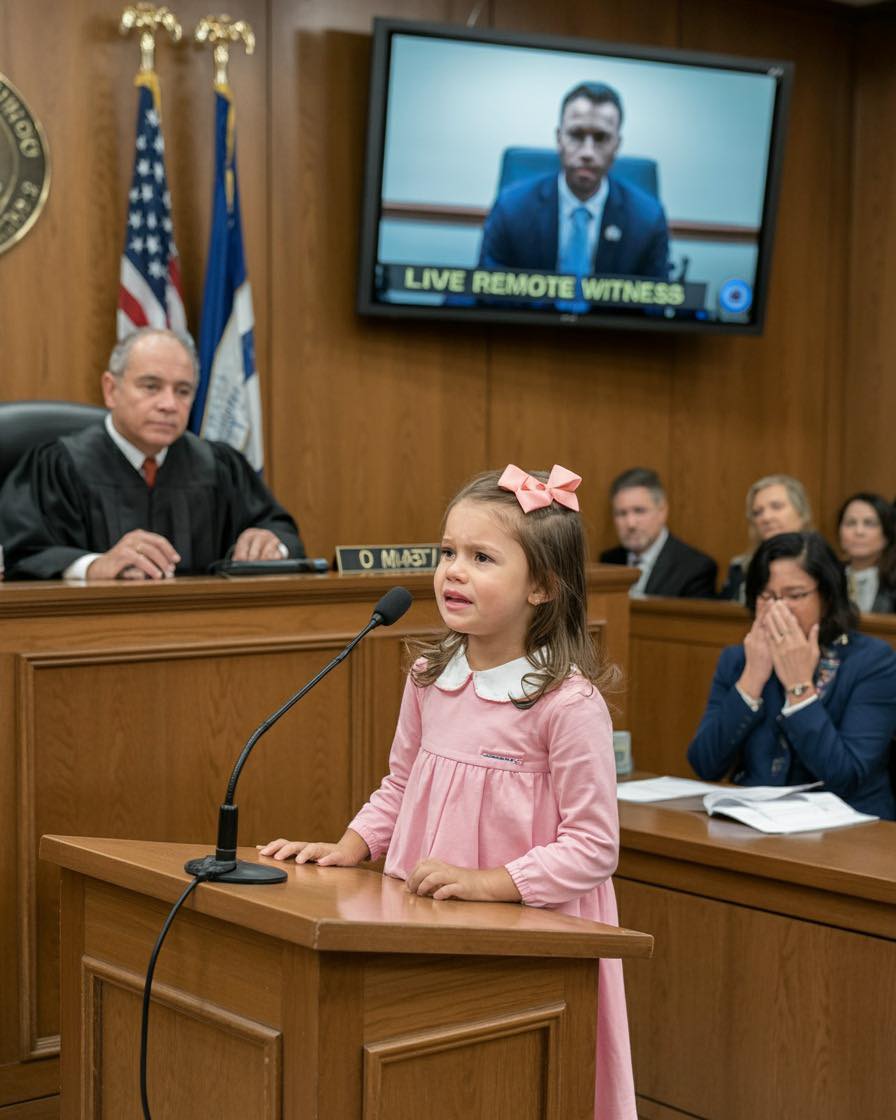
The first lie didn’t explode. It didn’t echo through the house or slam doors behind it. It slipped in quietly, almost politely, like something that expected to be believed simply because it had been said out loud. By the time the truth began to form, it didn’t arrive with authority or power. It arrived in the smallest possible form—wearing a school uniform, carrying a tablet, and holding onto a courage no child should ever have to find.
The courtroom that day felt heavier than usual. The air was thick with rehearsed arguments, legal language, and the familiar rhythm of adults trying to outmaneuver one another. At the center of it all sat a father who looked relaxed, almost bored, as if the outcome had already been decided in his favor. Across from him, a mother whose voice had grown quieter with each passing hearing, her truth worn thin by doubt and disbelief. And somewhere between them stood a child who had been watching everything far longer than anyone realized.
She had learned early that words alone weren’t enough.
The folder began as something small. It wasn’t part of a plan, not at first. It was just a name typed into a tablet—“For when I no longer believe you.” Even then, she didn’t fully understand what she was doing. But something inside her knew that memory fades, that stories can change, and that adults are very good at convincing others of things that aren’t entirely true.
At first, the folder stayed empty. Then came the first entry: a short video clip, recorded without ceremony. A moment that didn’t seem important to anyone else, but felt wrong to her. That feeling—the quiet, persistent sense that something wasn’t right—became her guide. She didn’t confront. She didn’t argue. She observed.
Days turned into weeks, and the folder grew.
There were recordings of conversations that didn’t match the stories later told in court. Screenshots of messages that shifted tone depending on the audience. Small inconsistencies that, on their own, could be dismissed—but together began to form a pattern. She wasn’t looking for proof of something dramatic. She was simply trying to understand why things didn’t add up.
Meanwhile, the adults continued their battle in the open.
Lawyers exchanged documents filled with confident claims. Statements were polished, rehearsed, and delivered with conviction. The father’s narrative was simple, persuasive, and easy to believe. He appeared composed, reasonable, even charming. The kind of person who didn’t seem capable of the things being quietly suggested behind the scenes.
The mother, on the other hand, struggled to be heard. Her attempts to explain were often dismissed as emotional, inconsistent, or exaggerated. Without hard evidence, her words were weighed against his—and too often, they fell short.
But the child kept watching.
She began to notice things others missed. The way certain conversations happened only when no one else was around. The subtle shifts in behavior depending on who was present. The careful construction of an image that looked flawless from the outside but didn’t hold up under closer inspection.
Her recordings became more deliberate.
She learned when to press record. When to stay silent. When to let a moment unfold without interruption. It wasn’t something any child should have to learn, but she adapted. Not out of defiance, but out of necessity. Because somewhere along the way, she realized that if she didn’t keep track of the truth, no one else would.
The day of the hearing arrived quietly, like all the others.
There was no indication that this one would be different. The same courtroom. The same arguments. The same tension that had come to define these proceedings. But there was one difference no one else could see.
She brought the folder with her.
At first, it went unnoticed. The adults spoke as they always did, presenting their versions of reality with practiced ease. The father remained confident, leaning back as if the outcome was inevitable. The mother sat still, her hands clasped tightly, her hope fragile but not entirely gone.
Then, at a moment that felt almost accidental, the child spoke.
Her voice wasn’t loud. It didn’t demand attention. But it carried something stronger than volume—clarity.
She asked the judge a single question.
It wasn’t complex or dramatic. It didn’t accuse or attack. It simply pointed toward something that hadn’t yet been considered. A small opening in a narrative that had gone unchallenged for too long.
The courtroom shifted.
There was a pause, brief but noticeable. The kind of silence that happens when something unexpected interrupts a familiar pattern. The judge looked at her, then at the tablet in her hands.
“What do you have there?” came the question.
She didn’t hesitate.
With steady hands, she opened the folder.
What followed wasn’t a sudden revelation, but a gradual unraveling. Video by video, message by message, the carefully constructed story began to lose its shape. The recordings didn’t shout. They didn’t exaggerate. They simply showed what had happened, exactly as it had happened.
Moments that had been denied were suddenly undeniable.
Statements that once seemed consistent now contradicted one another.
The father’s confidence faded, replaced by something less certain. The ease with which he had navigated previous hearings disappeared, replaced by the realization that this time, the narrative wasn’t entirely under his control.
The judge watched closely.
Each piece of evidence added weight. Not because it was dramatic, but because it was consistent. It revealed a pattern that couldn’t easily be dismissed. A pattern of manipulation, of carefully managed appearances, of truths that shifted depending on who was listening.
By the time the last recording played, the room felt different.
Not louder. Not more chaotic. Just clearer.
The decision that followed wasn’t immediate, but its direction had already begun to change. The custody arrangement that once seemed fixed was now being reconsidered. Questions were asked that hadn’t been asked before. Assumptions were challenged.
And at the center of it all stood a child who had simply refused to ignore what she saw.
The outcome, when it came, was significant.
The custody order was adjusted. Protections were put in place. The narrative that had once dominated the courtroom no longer held the same power. It wasn’t a dramatic victory, not in the way stories often portray them. There were no cheers, no sudden resolution of every conflict.
But it was enough.
Enough to change the direction of things. Enough to create space for something safer, more stable.
Yet the most important change didn’t happen in the courtroom.
It happened later, on a quiet afternoon in January.
There was no audience. No legal arguments. Just a moment that passed almost unnoticed. She sat at a table, working on something small—homework, maybe, or one of the bead bracelets she liked to make. For the first time in a long while, her shoulders weren’t tense.
Someone asked her how she felt.
She thought about it, just for a second.
“I don’t feel like I have to watch everything anymore,” she said.
It was a simple statement. Easy to miss if you weren’t paying attention. But it carried the weight of everything that had come before it.
Because for so long, watching had been her responsibility. Not by choice, but by necessity. It had shaped how she moved through the world, how she listened, how she understood the people around her.
And now, slowly, that responsibility was lifting.
Life began to return to its proper size.
There were school assignments to finish. Small arguments about bedtime. The quiet satisfaction of completing something simple and ordinary. The kind of moments that don’t make headlines, but matter more than anything else.
The folder still existed, of course. It hadn’t disappeared. But it was no longer something she needed to add to every day. It became what it was always meant to be—a boundary, rather than a burden.
A reminder that truth matters, even when it’s inconvenient.
That clarity can come from unexpected places.
And that sometimes, the smallest voice in the room is the one that changes everything.
In the end, what she carried into that courtroom wasn’t just evidence.
It was proof that paying attention—quietly, consistently, without recognition—can make a difference.
And in the stillness that followed, there was space again for something simple.
A safer home.
A lighter heart.
And maybe, just maybe, enough room to finally ask for that dog.