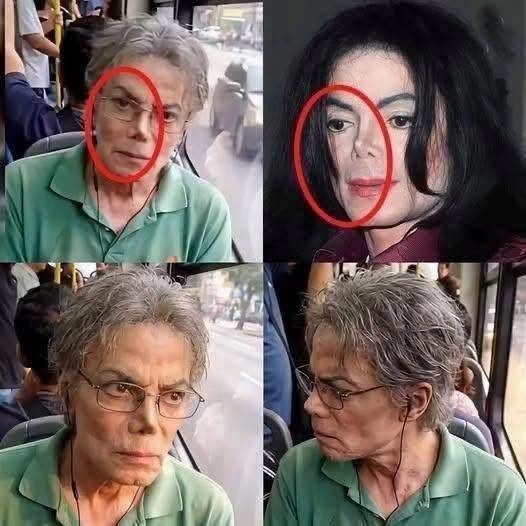
Michael Jackson Look-Alike Spotted on a Bus in Mexico Sparks Wild Reactions Online
A seemingly ordinaryphotographtaken on public transportation in Mexico has captured the attention of social-media users for one unexpected reason: the passenger in the picture bears a striking resemblance to Michael Jackson.Stream Pop Hits
The image shows an older man sitting quietly on what appears to be a bus. There is nothing particularly unusual about the setting. He seems to be another passenger going about his day.
Once people began looking more closely at his face, the photograph suddenly became much more interesting.
To some viewers, the man’s facial features, hairstyle, expression and overall appearance looked surprisingly similar to the late King of Pop.
It did not take long for the photograph to begin generating reactions online.
Some people commented on the resemblance. Others joked that they had to look at the picture more than once before realizing they were not actually looking at Michael Jackson.
Some social-media users took the joke one step further.
“What if Michael Jackson never died?” became the kind of playful question attached to the image.
For fans who remember Jackson’s unmistakable appearance during the later years of his career, the photograph can certainly produce a moment of surprise. Seen quickly, especially without any context, the passenger may look familiar enough to make someone stop scrolling.
An uncanny resemblance is not evidence of a hiddencelebrity.Follow Stars
There is no credible evidence that the passenger in the photograph is Michael Jackson, nor is there reliable evidence supporting the recurring internet theory that Jackson secretly survived his reported death.
The image is another example of something social media has become remarkably good at producing: a viral celebrity look-alike mystery.
An Ordinary Passenger With an Extraordinary Resemblance
Part of what makes the photograph so effective is how ordinary everything around the man appears to be.
There are no photographers surrounding him.
There is no dramatic setting suggesting that the image was deliberately created as a celebrity impersonation.
He simply appears to be sitting on public transportation.
That ordinary setting makes the resemblance even more surprising.
Michael Jackson was one of the most recognizable entertainers of the modern era. For decades, his appearance was seen on television screens, magazine covers, concert posters, album artwork and newspapers around the world.Stream Pop Hits
His face became deeply familiar to generations of music fans.
So when someone appears in an unexpected place with features that remind people of Jackson, recognition can happen almost instantly.
A hairstyle, the shape of the face, the eyes, the nose, an expression or even the angle at which a person isphotographedcan create a powerful impression.
For a moment, the brain fills in the rest.
That appears to be much of the appeal surrounding this photograph.
People know logically that Michael Jackson died years ago. Yet the visual similarity is strong enough for some viewers to enjoy the brief illusion.
And that is exactly the kind of moment that social media can turn into a viral conversation.
The bus itself adds to the effect. Fluorescent lighting, a narrow seat, a window behind the passenger, and the casual posture of someone mid-journey all signal everyday life. Against that background, any strong likeness to a global star feels sharper. The mind expects ordinary faces on ordinary transit. When a face arrives that matches a famous template, attention locks on.
“What If Michael Jackson Never Died?”Stream Pop Hits
Whenever photographs like this circulate, playful speculation is almost guaranteed.
The Michael Jackson image is no exception.
Some reactions reportedly focused simply on how similar the passenger looked to the singer. Others jokingly suggested that Jackson had somehow escaped public attention and was now living an ordinary life.
As an internet joke, it is easy to understand why the idea spreads.
Michael Jackson died in Los Angeles on June 25, 2009.
His death was not merely reported through celebrity gossip or anonymous online posts. It became the subject of an official death investigation and extensive subsequent legal proceedings.
The Los Angeles County Department of Medical Examiner is the government agency responsible for investigating deaths within its jurisdiction that fall into categories such as sudden, violent or unusual deaths. Its work includes determining the circumstances, cause and manner of qualifying deaths.
That makes the official record fundamentally different from the theories and jokes that sometimes circulate online.Book Comedy Shows
There is no credible documentation establishing that Jackson survived and secretly began living elsewhere.
The man on the bus may look remarkably like him.
[KEEP THE ORIGINAL IMAGE HERE — SAME IMAGE AND POSITION AS IN THE ORIGINAL ARTICLE]
The Official Record Matters More Than a ViralPhotograph
It is easy to understand why mysterious images attract attention.
People see a face and react before they have time to investigate the story surrounding it.
When an online claim conflicts with an established historical event, the evidence behind each side matters.
In this case, one side consists of an unidentified or insufficiently identified man in aphotographwho resembles a famous performer.Edit Photos
The other consists of the documented death of Michael Jackson in Los Angeles in 2009 and the official processes that followed.
Those are not equivalent forms of evidence.
The Los Angeles County Department of Medical Examiner explains that California law requires the department to inquire into and determine the circumstances, manner and cause of deaths falling within its jurisdiction, including sudden, violent and unusual deaths.
Its investigations can involve scene investigation, interviews, examinations, autopsies and laboratory testing when appropriate.
The department also maintains records connected with high-profile celebrity deaths.
This does not mean people cannot have fun with a celebrity resemblance.
It means a viral photograph should not be treated as proof of an extraordinary claim when far stronger evidence points in the opposite direction.
The distinction between entertainment and evidence is especially important online, where jokes can easily lose their original context.
Official records carry weight because they are produced under legal duty, with procedures designed to establish cause and manner of death. A single image shared across platforms carries no equivalent process. Treating the two as equal sources confuses amusement with verification.Get Photo Storage
The fascination with celebrity doubles existed long before social media.
For generations, people have made careers impersonating famous singers, actors and political figures. Some performers naturally resemblecelebrities, while others use makeup, hairstyles, costumes and carefully practiced expressions to strengthen the effect.
Certain celebrities have attracted particularly large communities of impersonators.
Elvis Presley is perhaps one of the most famous examples. Marilyn Monroe, Charlie Chaplin and other cultural icons have also inspired generations of professional and amateur look-alikes.
His distinctive fashion, hairstyles, dance movements and changing appearance over the course of his career gave impersonators numerous recognizable visual elements to reproduce.
Sometimes no deliberate impersonation is involved at all.
Two unrelated people can simply share certain facial characteristics.
When those similarities line up with the appearance of someone extremely famous, the effect can be startling.
Photography can make that resemblance appear even stronger.
Lighting changes the perceived shape of a face. Shadows can emphasize or conceal particular features. Camera lenses can subtly alter proportions. A photograph captured from one specific angle may make two people appear much more alike than they would if they were standing next to each other in person.
Hair, clothing and facial expression can complete the illusion.
That is why one photograph is rarely enough to establish someone’s identity.
It may be enough, however, to make millions of people look twice.
Professional impersonators rehearse posture and expression. Accidental doubles rely on chance alignment of bone structure, hair, and the moment the shutter fires. Both can produce the same scrolling pause. The bus photograph belongs to the second category: an unplanned capture that happened to hit a familiar pattern.
There is also a psychological reason celebrity look-alikes catch our attention so quickly.
Human beings are exceptionally sensitive to faces.
We routinely identify people from combinations of features rather than measuring every detail individually. Once a face becomes extremely familiar, relatively small visual cues can trigger recognition.
Think about how quickly you can recognize a close friend or family member from across a room.
You may not clearly see every feature, yet something about the person’s outline, hair, movement or face tells you who you think you are seeing.
Celebrityrecognition can work in a similar way.
Michael Jackson’s image was reproduced around the world for decades. Even people who were not devoted fans may recognize him almost immediately.
That familiarity means a stranger who shares enough of his visual characteristics can trigger the same mental pattern.
If someone posts thephotographwith a caption mentioning Michael Jackson, viewers are already primed to search for similarities.
They notice the matching features while potentially overlooking the differences.
The result can feel astonishing even when the explanation is simple.
Priming works fast. A caption that names the singer directs attention toward hairline, cheekbones, and expression. Without that caption, some viewers might scroll past. With it, the same features become evidence in a brief private trial the brain runs in under a second.
Why Social Media Makes These Images Explode
Before social media, an amusing celebrity look-alike photograph might have been shown to friends, relatives or coworkers.
Today, it can reach enormous audiences within hours.
The reason is simple: these images require almost no explanation.
The entire experience can happen in seconds.
Posts involving familiar celebrities also have a built-in advantage. Viewers already have an emotional connection to the subject.
Michael Jackson remains a globally recognizable figure, so an image that appears to show him—or someone very similar to him—immediately gives people something to discuss.
Was the resemblance obvious to the passenger who took the picture?
Questions like these encourage comments even when definitive answers are unavailable.
One person jokes that Jackson is secretly living in Mexico.
Someone else shares the photograph without explaining that the original comment was a joke.
After enough reposts, an amusing observation can begin to look like a genuine claim.
That is where a harmless viral moment can become misinformation.
Platforms reward speed and emotion. A look-alike post travels because it is easy to process and easy to pass along. Each share strips a little more of the original framing. By the time the image reaches a new audience, the joke may have hardened into a headline-style claim.
The internet has a peculiar way of removing information from its original setting.
Imagine that someone uploads a photograph and writes:
“This guy looks so much like Michael Jackson!”
A third account may remove the question mark.
“Michael Jackson spotted alive in Mexico.”
The claim surrounding the image has changed dramatically.
This process is one reason people should be cautious when encountering sensationalphotographswith little context.
Before accepting an extraordinary story, it helps to ask basic questions.
Where did the photograph originally come from?
Is the person in the photograph identified?
Are reputable news organizations reporting the same thing?
Is there independent evidence supporting the claim?
Or is everyone simply reposting the same photograph?
These questions can quickly separate an entertaining internet mystery from a credible news story.
In the case of the Michael Jackson look-alike, the resemblance itself may be genuine.
The conclusion that the person therefore must be Jackson is not.
Each repost is a small edit of meaning. Question marks disappear. Hedges disappear. What began as recognition becomes assertion. The visual file stays identical while the verbal frame around it drifts toward the extraordinary.
Michael Jackson’s Image Remains Instantly Recognizable
There is another reason the photograph resonates with so many people: Michael Jackson’s cultural presence did not disappear when he died.
During his career, Jackson became one of the most famous performers in popular music.
His music, performances, videos and visual style helped make him recognizable far beyond traditional pop audiences.
Even a silhouette could sometimes be enough for audiences to know who was being represented.
It also helps explain why alleged Jackson sightings continue to attract attention many years after his death.
For longtime fans, seeing someone who resembles him can trigger memories of music videos, concerts and major moments from their own lives.
Aphotographtherefore becomes more than a picture of a stranger.
It becomes a reminder of a performer they once watched and listened to.
Nostalgia can make the image emotionally powerful even when viewers know perfectly well that the person pictured is only a look-alike.
Cultural icons leave templates in memory. Those templates activate when a similar face appears in an unexpected place. The bus becomes a stage for a brief private concert of recollection. The passenger did not ask for that role. The culture supplied it.
CelebrityDeaths Often Generate Conspiracy Theories
Michael Jackson is hardly the first famous person whose death has inspired claims that he somehow survived.
Similar stories have surrounded other major cultural figures.
When someone becomes enormously famous, the public becomes accustomed to seeing that person everywhere. Their voice, face and work become part of everyday culture.
For some fans, that can be difficult to process.
A later photograph of someone with similar features can revive the feeling that perhaps the story is not over.
Social media then gives those theories an audience.
An anonymous social-media comment is not enough.
And repetition does not turn speculation into fact.
A claim shared ten thousand times is still only a claim if no reliable evidence supports it.
That principle is worth remembering far beyond celebrity stories.
Grief, fame, and pattern-seeking combine easily online. The result is a familiar cycle: a look-alike appears, a theory attaches, and the theory travels farther than the original observation. Returning to the official timeline restores proportion.
None of this means people are wrong to notice the resemblance in the photograph.
That is precisely what makes the image interesting.
The man really may remind viewers strongly of Michael Jackson.
People can debate whether the similarity is extraordinary or whether it is mostly the angle, hairstyle and expression.
They can send the photograph to friends who are Jackson fans.
The problem begins only when the joke is presented as evidence.
There is an enormous difference between saying:
“This man looks amazingly like Michael Jackson.”
“This proves Michael Jackson is still alive.”
The first is an opinion about appearance.
The second is a factual assertion requiring substantial evidence.
The photograph supports the first observation.
It does not support the second conclusion.
That distinction allows the story to remain entertaining without turning it into misleading information.
Opinion about likeness costs nothing and harms little. Assertion of identity after a documented death requires a standard of proof the photograph cannot meet. Keeping those two statements separate protects both the fun of the resemblance and the integrity of the historical record.
OnePhotographCan Never Tell the Whole Story
Images have enormous persuasive power because they appear to show us reality directly.
Every photograph captures only a fraction of a second.
We cannot necessarily determine a person’s identity, history or circumstances from that fraction of a second.
We do not know what happened immediately before or after the picture was taken.
We cannot see how the person appears from different angles.
We may not even know whether the caption attached to the image is accurate.
The internet often encourages the opposite behavior: react first, investigate later.
The most surprising interpretation receives the most attention.
“Man resembles Michael Jackson” is interesting.
“Michael Jackson secretly found alive” is sensational.
Sensational claims naturally attract more clicks.
Being more exciting does not make a claim more accurate.
In fact, the more extraordinary a claim becomes, the more carefully its evidence should be examined.
A still frame freezes expression, angle, and light. Identity lives across many frames, documents, and verified records. Treating one freeze as a full biography is a category error the platforms reward and careful readers resist.
There is another person in this story who can easily be forgotten: the man in thephotograph.
To the internet, he may simply be “the Michael Jackson look-alike.”
He is also a real person who may have been doing something completely ordinary when the photograph was taken.
He may or may not know that his image has circulated.
Viral culture often transforms ordinary strangers into temporary internetcelebritieswithout much warning.
A facial expression, unusual outfit, coincidence or resemblance can suddenly be viewed by enormous numbers of people.
That is another reason to avoid attaching unsupported claims to images of strangers.
Inventing a false identity for someone is another.
The passenger did not stage a press appearance. Someone else captured a moment and the network did the rest. Respect for that person includes leaving the joke in the realm of resemblance and keeping claims of identity away from an unverified face.
A Viral Mystery With a Very Simple Explanation
In the end, the story does not require a secret disappearance, an elaborate conspiracy or a hidden second life.
Its appeal comes from something much simpler.
A man sitting on a bus in Mexico happens to remind people of one of the most recognizable entertainers in modern music history.
And because Michael Jackson remains such a familiar cultural figure, the photograph had everything necessary to spread.
There is no credible evidence that the man is Jackson.
There is no reliable evidence that Jackson secretly survived his death in 2009.
The official historical record remains unchanged.
What the photograph does provide is a fascinating example of how quickly our brains recognize familiar faces—and how quickly the internet can transform that recognition into a viral mystery.
For some viewers, the resemblance may be uncanny.
For others, it may only become noticeable after someone points it out.
Either way, the image is likely to keep generating the same reaction:
Look again, and the more reasonable explanation becomes clear.
Sometimes a stranger really does look remarkably like a celebrity.
Sometimes the camera catches exactly the right angle.
Sometimes nostalgia makes a familiar face appear where we least expect it.
And sometimes the internet simply finds a perfect photograph for a joke.
The passenger in Mexico may have given social media an unforgettable Michael Jackson look-alike moment.
Resemblance should not be confused with identity.
Michael Jackson died in Los Angeles on June 25, 2009, and the available official record provides no basis for claims that he secretly survived.
So the photograph is best enjoyed for what it appears to be:
And another reminder that, on the internet, a single photograph can turn a stranger on a bus into the center of a mystery seen around the world.
Los Angeles County Department of Medical Examiner — official information on its responsibility for investigating and determining the circumstances, cause and manner of deaths within its jurisdiction.
Los Angeles County Department of Medical Examiner, “Our Process” — explanation of death investigations, examinations, autopsies and laboratory testing.
Los Angeles County Department of Medical Examiner, Public Services — information concerning Medical Examiner records, including records involving high-profilecelebritydeaths.